

Native Hedge Planting: Why and How to Plant a British Hedgerow
Why We Love A Native Hedge
Why and how should you plant a hedge using native British plants? Not enough people do plant them; they're a fantastically under-appreciated resource. They have a history going back to the bronze age - THE BRONZE AGE! - making them one of the oldest man made features in the British landscape. According to Hooper's Rule here in our bit of Somerset we're surrounded by medieval hedges.

Why a Native Hedge?
Native plants make a good, fast growing privacy hedge, which is recommended for security too. They’re also beautiful things and a fantastic resource for wildlife and foragers. A recent study identifed 2070 species in an 85m stretch of Devon hedge. Our native flora and fauna have special relationships. Mixed hedges using native species are easy to recreate and manage to different sizes, and I’m always surprised that more folk don’t go for them.
Our native British hedge plants seem to me to be a bizarrely under-utilised resource in urban environments too. Here they can significantly help to reduce pollution, and offer an easy way to sequester carbon when you haven't got the space for woodland planting. Hedges are good windbreaks; these kind of semi-permeable barriers are ideal for dramatically reducing airflow. They can also significantly reduce water run-off.
Perhaps people associate them with unruly country hedges, when they want a clean and tidy look. In which case, what about a clipped single species? Other native plants can be as architectural as yew or box; use Hawthorn, for example.

There's Beech or Hornbeam, perhaps, for privacy. You could add some of our native Honeysuckle, Lonicera periclymenum, or Dog rose, Rosa canina (as left) for colour.
To my mind, though, the more species in a hedge the better, if for no other reason than increasing its associated biodiversity. You can, of course, prune a mixed hedge to keep it to a certain size too. Structurally mixed hedges look sounder to me as well; you need a good mix of suckering species like Blackthorn and Hazel to continue to give it a good thick base. I also like the kaleidoscope of spring and autumn colours they bring.
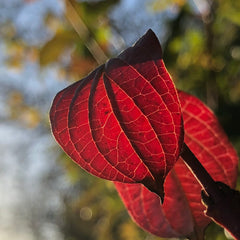
And these mixed hedges can look stunning. Commonplace plants can be real lookers, and not just when in flower. Their autumn colours are often lovely; the yellow of Field maple, burnt reds and oranges of Guelder rose, impossibly pink and orange Spindleberries, and the dark red of "common" dogwood, Cornus sanguinea (shown).
A traditional mixed hedge is excellent for security. If they've kept cows and sheep out for hundreds of years, they'll deal with people too! Hawthorn and Blackthorn - the clues are in their names - make impenetrable barriers. Hawthorn's synonym - "Quickthorn" - also tells you how fast it will grow.
Native hedge plants make good visual screens too. Beech and Hornbeam keep their leaves in hedges, and Yew, Holly and Privet are helpful evergreens.

Hedges and Wildlife

As with all our native plants, common hedge species have unique relationships with our native fauna. When they think about the food that they provide most people think about the berries and fruit for birds and small mammals – and larger mammals like gardeners! There’s a largely unnoticed community of animals further down the food chain as well, which depends on a hedge for other forms of sustenance. Our butterflies and moths have unique relationships with native plants, many of which you can include in a hedge. The Yellow Brimstone, for example, lays its eggs on Buckthorn, on which its caterpillars feed exclusively. Brown Hairstreak has a similar relationship with Blackthorn.

Think of the number of plants in a native hedge and you can imagine the volume of pollen and nectar even a short length will produce, as opposed to individual plants in a garden. The mix of species also ensures a long flowering period – there’s rarely a time outside the winter months when something isn’t in bloom. Hereabouts it’s the Blackthorn blossom in early spring which saves the honey bees from starving, and at the end of the season the ivy in autumn lets them stock up for winter on warm autumn days. Different flowers attract different pollinators, so a mixed native hedge will support a whole range of species.
Plants like blackthorn and hawthorn (blossom shown above) also provide fantastic shelter for invertebrates, small mammals and birds. Hedges are handy corridors for wildlife too, and offer relative safety for animals while they move about. One of the issues exercising the conservation lobby at the moment is the fragmentation of good quality habitat, which need to be joined up. Hedges can be a pretty good way to do it, at least on a small scale. Animals don't just use them as "wildways", but also as navigation features. Bats use them to find their way across the landscape, for example, and bumblebees fly along them too.

Starting a Hedge
It couldn’t be easier to start a native hedge – after all, these are our British plants, so it should be easy to grow them! Before you start, prepare the ground by weeding a strip about a metre wide, removing grass as well. If you have livestock, think about whether it would be best to wire the hedgeline before or after you plant your new whips. Don’t under-estimate the width your hedge will grow to.
Find a good quality supplier of British plants. There are plenty online, but do look carefully - please source your plants from a British nursery. Some of the large scale hedge renovation over the last 50 years has used plants from all over Eastern and Western Europe. There are lots of reasons to use hedge plants with British provenance, not least biosecurity. Some suppliers are either coy about provenance or infer it, so do ask. You want plants which are not only grown here, but originate from seed collected in Britain too. Look for the Plant Healthy certification mark.
You’ll need 5 plants per linear metre to create a stockproof staggered double thickness hedge. DEFRA have suddenly decided you need 6 for their BN11 funding option, but we're not sure why. We usually recommend something up to 50cm between rows. That’s not to say your hedge must look like that. You might not have enough room for two rows of plants, for example, although the thicker the hedge the better from the point of view of wildlife. Some folk want a really thick, triple thickness hedge (7 plants a metre). If you wanted something optimal for a "wildway" you could plant rows up to 1m apart.
Many woodland nurseries sell a “conservation hedge mix”, or "mixed traditional" or "country hedge", which should be a good diverse default mix for the agnostic, and will qualify for grants. It will be Hawthorn based and suitable for a wide range of situations and soils and consists of species widespread across the UK. If there are plants in it you don’t want or plants you particularly do, the nursery will usually happily tweak it for you. We don’t suggest using Blackthorn in a hedge next to a lawn, for example, because it suckers freely. On the other hand, you do want some suckering species, like dogwood and hazel, to help thicken up the hedge. You may also have a particular soil type or site which suits some species more than others.
All this means that a mix with the most species possible is ideal; it will give you all year round interest and an extended flowering window, plus the biggest range of foodplants and hedgerow fruit.

Farmers often buy the smallest size plant on offer, which is often 40-60cm. Unless your site is very exposed, personally I’d stretch to the next one up, 60-90cm, which is the size we used in the picture. They’re still pretty small whips, which are easily planted and quick to establish. There's no point buying anything bigger as you’ll end up with a hedge with no bottom.
The whips will be bare root as they're much easier to transport and will take much better than pot grown. They're consequently delivered from November until the end of March while they are dormant. They should arrive in special packaging, so will sit in the shed/garage quite happily for several days. If you're not planting them for a longer period, heel them in somewhere.
When you do get around to planting, the key thing is to keep the wind drying roots out. I march around with the whips in a bucket of water. We use Rootgrow now too, which encourages rapid establishment. The other big issue is frost; don’t try sticking them into frozen ground. They’re easy to plant, particularly if you have a two person planting team. One of you needs to open a slit in the ground with a spade and the other just pops a whip in and treads around it. Snip a few inches off the top of the whip to encourage the development of lateral branches.

If you have rabbits or deer you will also need the ubiquitous spiral guard and cane. These will support young plants and reduce the effects of wind rock as well as protecting young hedge whips, particularly against strimmers, rabbits and voles. The guards are now available in compostable form, thank goodness, which we'd recommend over the older ones, which shatter into smaller and smaller pieces if left in place. Not great. Practical biodegradable guards are now available. They're more expensive but you don't have to remove them.

Hedge Management
First off, you MUST keep the base of your native hedge clear of weeds and grass. The whips don’t need to compete with perennial weeds while they are getting established. If you don’t use a mulch then you’ll have to weed for a couple of years, but wood chip should help. We don't generally recommend using strips of plastic or hessian mulch as the voles love to hide under them and eat your new plants' roots! Wood chips can be a great solution, particularly from trees like willow.
We don't generally recommend watering (these are tough plants!) but if you do really have to, make sure you water regularly and in decent volume. Poor watering is a lot worse than no watering at all.
Once established - after a couple of years - remove hedge guards and canes if you have used them. The bioguards should compost down, but the plastic ones will have to go to the nearest recycling centre.
Leave the odd whip to grow on and form a hedgerow tree, if you're planting a long new section. I always reckon it's best to concentrate on smaller species, particularly if the hedge is running North / South. Field maple, Crab apple and Myrobalan all suggest themselves.

Without plant management, in a few years’ time you’ll have a different problem to deal with. Although we’ve pretty much arrested the decline in the length of hedgerows in the UK, many are now vestigial - just rows of the occasional small tree. Left unattended, at best your native hedge will go vertical, which is less helpful for all than a dense hedge with a wide base. In the worst case, lack of management over time means no hedge at all.
The ideal way to ensure a perfect hedge is to lay it, but that’s often not practical.

If you can please do - but that's a whole different blog ! You'll be able to start hedgelaying a few years after planting, when the Hawthorn has reached a couple of metres height. Here's a section of largely Hazel hedge I laid recently. If you're trimming instead, establish a regime that impacts the least on local wildlife, though. The Single Payment scheme asks for hedge cutting to stop between 1st March and 31st July, but the optimal time to do it is January and February. That's after the berries have been eaten but before birds start nesting.
Don’t butcher a hedge to an inch of its life, as you often see flails do, but trim it in a two or three year rotation to let it fill out. Allow it to keep10cm of new growth every year. DEFRA quite sensibly specify a 2m wide uncultivated zone from the middle of the hedge.
When you need to take extreme action to get a really overgrown hedge back under control and you can't lay it, coppice it in sections, year by year, to minimize the impact on wildlife. This will typically be once in a generation. Ideally, gap up a hedge while renovating it with locally sourced whips in keeping with the species you see around you.


