Native Plants for Wildlife Hedges

If you are interested in buying plants to make a wildlife hedge, in addition to the individual species listed below you might also like to look at our conservation hedge mix, stock friendly hedge mix, or edible hedge mix.

All the plants are bare root, and are consequently available for delivery from November until March, depending on weather conditions. We will only charge your debit/credit card when the plants are ready for delivery.

Common Beech (Fagus sylvatica)

Common Beech (Fagus sylvatica)
The majestic Beech has been here since before we were an island - pollen in Hampshire has been dated back to 6000 BC. It is an antisocial tree, growing best among its own - hilltop beech groves are one of the most beautiful landscape features of Southern chalk downlands. It is adaptable, growing in moist soils and tolerant of shade, but it is vulnerable to dry conditions and grey squirrel damage.

View more information and Purchase Options
Blackthorn (Prunus spinosa)

Blackthorn (Prunus spinosa)
Blackthorn is a fine hedge plant, slow growing but suckering freely and having needle like spines. Its habit makes it a fabulous refuge for small birds and mammals, who feast on its sloes, and a raft of moth and butterfly caterpillars feed on it. It is tough as old boots, and as a hedging plant lays well and forms a good stockproof - and people proof - barrier. Its prolific white flowers are an important nectar source in spring.

View more information and Purchase Options
Alder Buckthorn (Rhamnus frangula)

Alder Buckthorn (Rhamnus frangula)
Alder Buckhorn is a large shrub with glossy green leaves that turn yellow, contrasting with red berries in the Autumn. It prefers damp, peaty sites, and unlike Purging or Common Buckthorn is thornless. Both Buckthorns are, however, the only foodplants of the Brimstone butterfly.

View more information and Purchase Options
Purging Buckthorn (Rhamnus cathartica)

Purging Buckthorn (Rhamnus cathartica)
Common or Purging Buckthorn is an upright, spiny shrub usually found in scrub and hedgerows on chalky soil. Its black berries serve as what Richard Mabey describes as a "fierce" purgative. Both Buckthorns are the only foodplants of the Brimstone butterfly.

View more information and Purchase Options
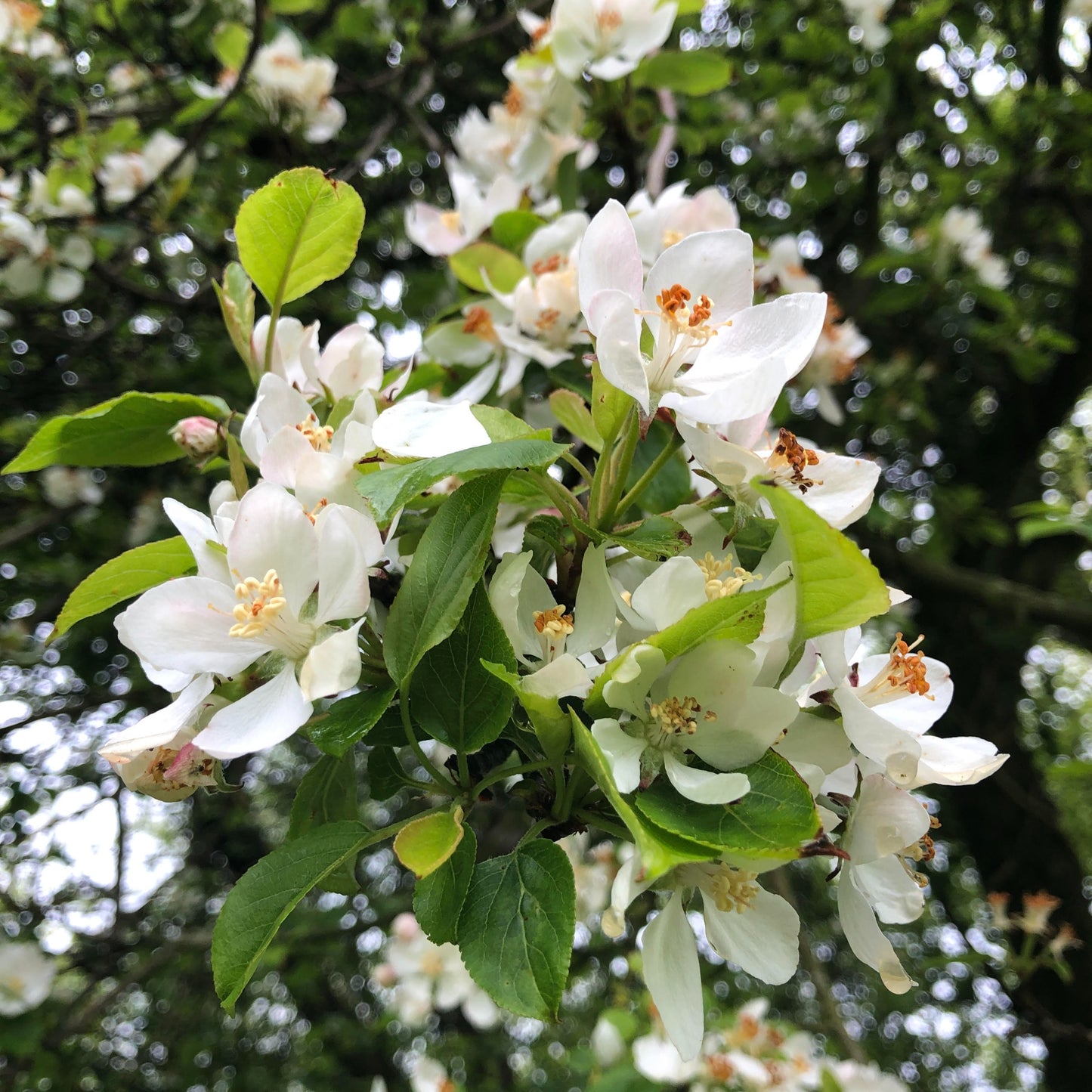
Crab Apple (Malus sylvestris)

Crab Apple (Malus sylvestris)
The Crab Apple is a small tree of woods and hedges throughout Britain. It's relatively scarce; mostly you will now find cultivated varieties or "wilding" apple trees. The Crab's extended flowering period (pretty pale pink blossom) is helpful for bees as much as it is for cross pollinating other apple trees, and its fruit makes delicious jelly for us and good winter eating for the birds.

View more information and Purchase Options
Common Dogwood (Cornus sanguinea)

Common Dogwood (Cornus sanguinea)
The Common Dogwood is a large, colourful and versatile shrub. It does well in most conditions and suckers freely, making it a good hedging plant. It has red spring twigs and autumn foliage, delicate white flowers in the spring, and black berries that attract birds.

View more information and Purchase Options
Common Gorse (Ulex europaeus)

Common Gorse (Ulex europaeus)
Gorse is a very spiny, fast growing evergreen shrub that bears masses of intense Broom-like yellow flowers from January to June . It is happiest on dry sandy soils with a southerly aspect. Its habit makes it a great refuge for small birds and mammals, and its flowers are a good source of nectar for bees and butterflies. It is also a food plant for several moth and butterfly larvae.

View more information and Purchase Options
Guelder Rose (Viburnum opulus)

Guelder Rose (Viburnum opulus)
In this case, a rose isn't a rose, but the Guelder Rose is, notwithstanding, a very beautiful shrub. It has large lobed leaves which turn well in the autumn, and globes of white flowers in early summer, followed by bright red fruit.

View more information and Purchase Options
Hawthorn (Crataegus monogyna)

Hawthorn (Crataegus monogyna)
The Hawthorn or Quickthorn is a fast growing tree, beautiful in flower. Its habit makes it an ideal refuge for small birds, who feast on its red fruit. It is tolerant of most conditions, and as a hedging plant lays well and forms a good stockproof - and people proof - barrier.

View more information and Purchase Options
Common Hazel (Corylus avellana)

Common Hazel (Corylus avellana)
Hazel's yellow catkins ("Lamb's tails") are an invaluable source of early pollen for bees, and its nuts, an iron age human staple, are a boon for small mammals. Not only is it an important hedging constituent because of its speed of growth and habit, but it is widely used for all manner of traditional coppice products.

View more information and Purchase Options
Common Holly (Ilex aquifolium)

Common Holly (Ilex aquifolium)
Holly is slow growing but tremendously useful, not only as an impenetrable evergreen screen, but also as it is very hardy; it grows in deep shade and on a wide range of well drained soil types. It is a good protective habitat for birds and small mammals, and of course they love the female plant's berries. Iti is the food plant of the Holly Blue. It transplants poorly, and we consequently sell it in containers rather than bare root.

View more information and Purchase Options
Common Hornbeam (Carpinus betulus)

Common Hornbeam (Carpinus betulus)
This large spreading tree looks very similar to Beech, although it's not related and has an attractive fluted and sinewy trunk. It's a useful tree, holding its leaves in winter in a hedge (although not as a tree) and tolerating surpringly deep shade. Its wood is amazingly tough, hence it being known as "Ironwood", and burns well.

View more information and Purchase Options
Field Maple (Acer campestre)

Field Maple (Acer campestre)
A beautiful medium sized but fast growing tree, often found in mixed hedging and mixed woodland. Its leaves turn bright yellow, then orange brown in the autumn. In spring it has small yellow flowers, succeeded by red fruit.

View more information and Purchase Options
Myrobalan (Prunus cerasifera)

Myrobalan (Prunus cerasifera)
Myrobalan, or Cherry Plum, was introduced to Britain from Asia, but so long ago we have included it here. It is a useful fast growing small tree, with occasional spines. It lays well, and looks good in a hedge We have a couple on our orchard, however, as they are among the first trees into blossom (from February), and their masses of pretty white flowers swarm with honeybees on a warm day. They will occasionally also bear fruit, which is red or yellow and rather sharp, but good for jam.

View more information and Purchase Options
Wild Pear (Pyrus pyraster)

Wild Pear (Pyrus pyraster)
Like the Crab Apple, the Wild Pear is distinct from feral pears from pips. It is a slow growing small tree, tolerant of most well drained soils. Pretty white blossom, but then its fruit is hard and inedible to humans - not, however, to a myriad of small mammals.

View more information and Purchase Options
Wild Privet (Ligustrum vulgare)

Wild Privet (Ligustrum vulgare)
Wild Privet is only semi-evergreen, and rather larger and less compact than the Garden Privet which superceded it in gardens. It is a fabulous wildlife shrub, however. Its small flowers attract insects, and birds (especially Thrushes) enjoy the cover it affords and its black berries, which are poisonous to humans. Furthermore, it is a foodplant for a number of butterfly and moth larvae.

View more information and Purchase Options
Dog Rose (Rosa canina)

Dog Rose (Rosa canina)
Of the 14 native species of rose, the Dog Rose is the most common. It carries sweet-scented pink or white blooms and red hips in the autumn. It's a good plant for wildlife, offering a protective habitat and food supply for birds and small mammals, nectar for insects and bees, and a foodplant for several moths and butterflies.

View more information and Purchase Options
Field Rose (Rosa arvensis)

Field Rose (Rosa arvensis)
The Field Rose has white flowers with golden anthers and a heady scent. It is a scrambler with arching stems, less tall than the Dog Rose. It's a great plant for hedging offering a protective habitat and food supply for birds and small mammals, nectar for insects and bees, and a foodplant for several moths and butterflies.

View more information and Purchase Options
Spindle (Euonymus europaeus)

Spindle (Euonymus europaeus)
Spindle, or Spindleberry, is a very pretty shrub/small tree, with tiny flowers in Spring followed by dayglow pink berries enclosing orange seeds. In the unlikely event you don't spot them, you will see its beautiful Autumn foliage. It is found in ancient woods in hedgerows in the South. Beware - it is known to herbalists as a strong purgative.

View more information and Purchase Options
Wayfaring Tree (Viburnum lantana)

Wayfaring Tree (Viburnum lantana)
Another Viburnum, like the Guelder Rose, widely distributed in the south on chalk. It has creamy white lily scented flowers in May - June which attract bees and butterflies, and are followed by red berries that turn black as they ripen.

View more information and Purchase Options
Bay Willow (Salix pentandra)

Bay Willow (Salix pentandra)
Bay Willow is a handsome small tree naturally found in Northern areas. Its leaves smell of Bay when crushed. Male trees produce bight yellow catkins in early Summer.

View more information and Purchase Options
Crack Willow (Salix fragilis)

Crack Willow (Salix fragilis)
Small and rapid growing, pollards have lived as long as 1000 years across the UK. Unpollarded, they tend to split open under their own weight. Among its dependent species is the spectacular Purple Emperor, for which it is a foodplant. Evelyn, writing in the 17th century when it was also known commonly as "sally" or "wully", thought the roots slower growing but deeper than other salix.

View more information and Purchase Options
Goat Willow (Salix caprea)

Goat Willow (Salix caprea)
The odd one out - Goat Willow (or Pussy Willow, or Sallow) doesn't necessarily need wet. In the female form it has silver catkins. We have a beautiful old tree in the village that is covered with our bees as soon as it comes into flower. Useful for the church flowers, too.

View more information and Purchase Options
White Willow (Salix alba)

White Willow (Salix alba)
White Willow is identified by its beautiful silvery leaves, and often found with Alder. It is the largest of the British species. Together with Osier, a non native shrub species, it is traditionally used for making baskets and hurdles.

View more information and Purchase Options